Why one wheel spins while your car stays stuck
Rev Theory is a car explainer channel. We take one thing you've felt from the driver's seat, open up the parts behind it, and show what's going on with original animation. No stock footage, no fluff. Episode 1 is the classic: snow, one screaming wheel, zero progress.
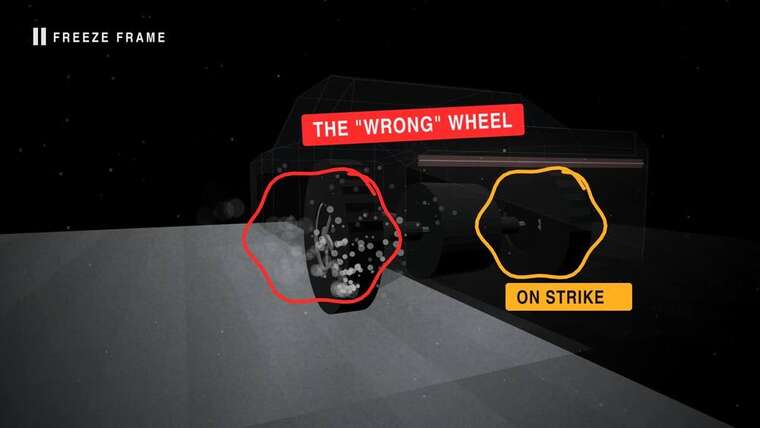
Episode 1: the one-wheel spin
You're at a stop sign after fresh snow. You press the gas and one wheel spins like crazy. The other one doesn't move at all. It feels like your car picked the worst possible wheel on purpose. It didn't break, though. That behavior comes from the part between your driven wheels: the differential.
Why the differential exists: corners
Every time you turn, the outside wheel travels farther than the inside wheel. In a tight 90° turn with a 5 m inside radius and a 1.6 m track width, the inside wheel covers about 7.9 m and the outside wheel about 10.4 m, roughly 2.5 m (8 ft) more. Bolt both wheels to one solid axle and one tire has to scrub, hop or slide to make up the gap.
What's inside
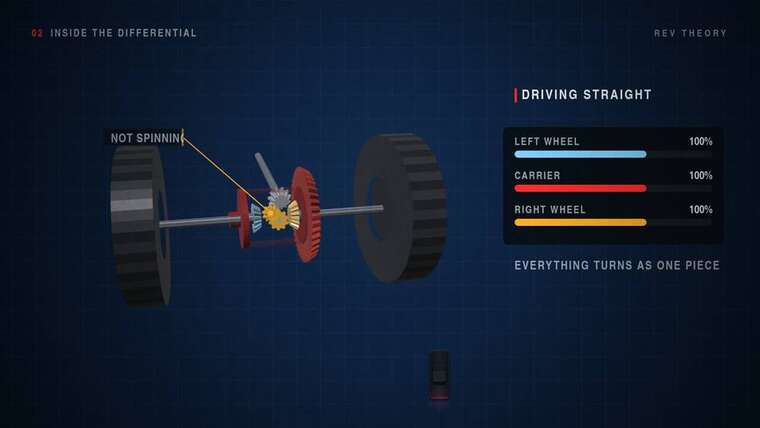
The driveshaft spins a small pinion gear, which turns a large ring gear bolted to a cage called the carrier. Inside the carrier, small spider gears on a pin mesh with two side gears, one for each wheel. Driving straight, the whole cage turns as one piece. In a turn, the spider gears roll on their pin so one wheel speeds up while the other slows down by the same amount.
The catch: equal torque
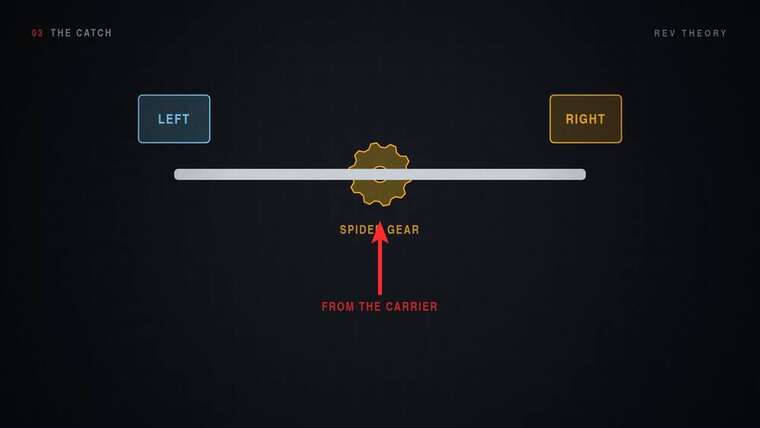
The spider gear acts like a seesaw. It pushes on both side gears equally, so an open differential sends the same torque to both wheels. The whole system can only push as hard as the weakest wheel can push back.
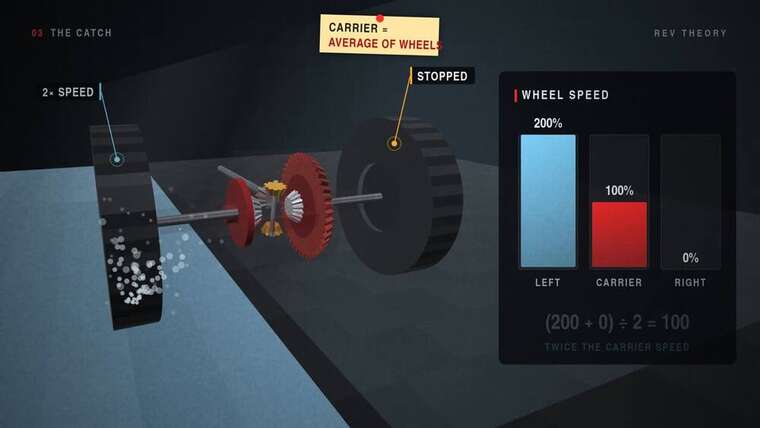
Put one tire on ice and it breaks loose with almost no torque. The tire on dry pavement gets that same tiny amount, which isn't enough to move the car. Remember the average rule: if the dry wheel is stopped, the icy wheel has to spin at twice the carrier's speed. The torque is split evenly, but the power isn't. Nearly all of the engine's work goes into spinning one wheel on the ice.
How engineers cheat it
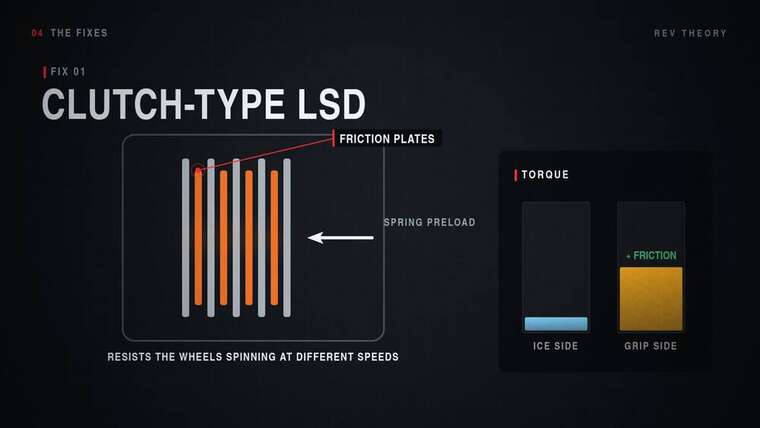
Friction plates resist the wheels turning at different speeds, so some torque reaches the wheel with grip.
"Torque sensing." Worm gears let the grippy wheel take up to about 3× the slipping wheel's torque at a 3:1 bias. But 3 × zero is still zero if a wheel is in the air.
Ties both wheels together so they turn at the same speed. Great off road, but it fights you in tight turns on pavement.
Brakes the spinning wheel. That wheel finally pushes back, so torque goes up on both sides.
What to do when you're stuck
- Don't floor it. More throttle just spins the icy wheel faster.
- Ease into the throttle and let traction control do its job.
- Check your owner's manual for what your car recommends in deep snow. Some manuals suggest turning traction control off to rock the car free.
Stuck-in-snow kit
The gear we'd actually keep in the trunk for a winter like this. Winter tires do more than anything else on this list, because grip is what an open diff runs short of.
More grip at each wheel raises the limit the open diff is stuck at.
Product links coming soonWedge them under the spinning tire to give it something to bite.
Product links coming soonOnly if your owner's manual allows them for your car.
Product links coming soonClear packed snow from in front of the driven wheels.
Product links coming soonCold weather lowers tire pressure, so check it more often in winter.
Product links coming soonSome links on this site may be affiliate links. If you buy through them, Rev Theory may earn a small commission at no extra cost to you. See our disclosure.
Sources
- Differential (mechanical device) — Wikipedia
- Onésiphore Pecqueur — Wikipedia
- Torsen — Wikipedia
- Locking differential — Wikipedia
- Limited-slip differential — Wikipedia